UNIT: BEHAVIORISM

Stimulus. Response. Reinforcement.

Explore the foundational theory that shaped language teaching through habit formation, drilling, and systematic practice. Behaviorism emerged in the early 20th century as a revolutionary approach to understanding how humans acquire new behaviors, including language. This theory fundamentally transformed language pedagogy by proposing that learning is an observable, measurable process rather than an internal mental phenomenon.
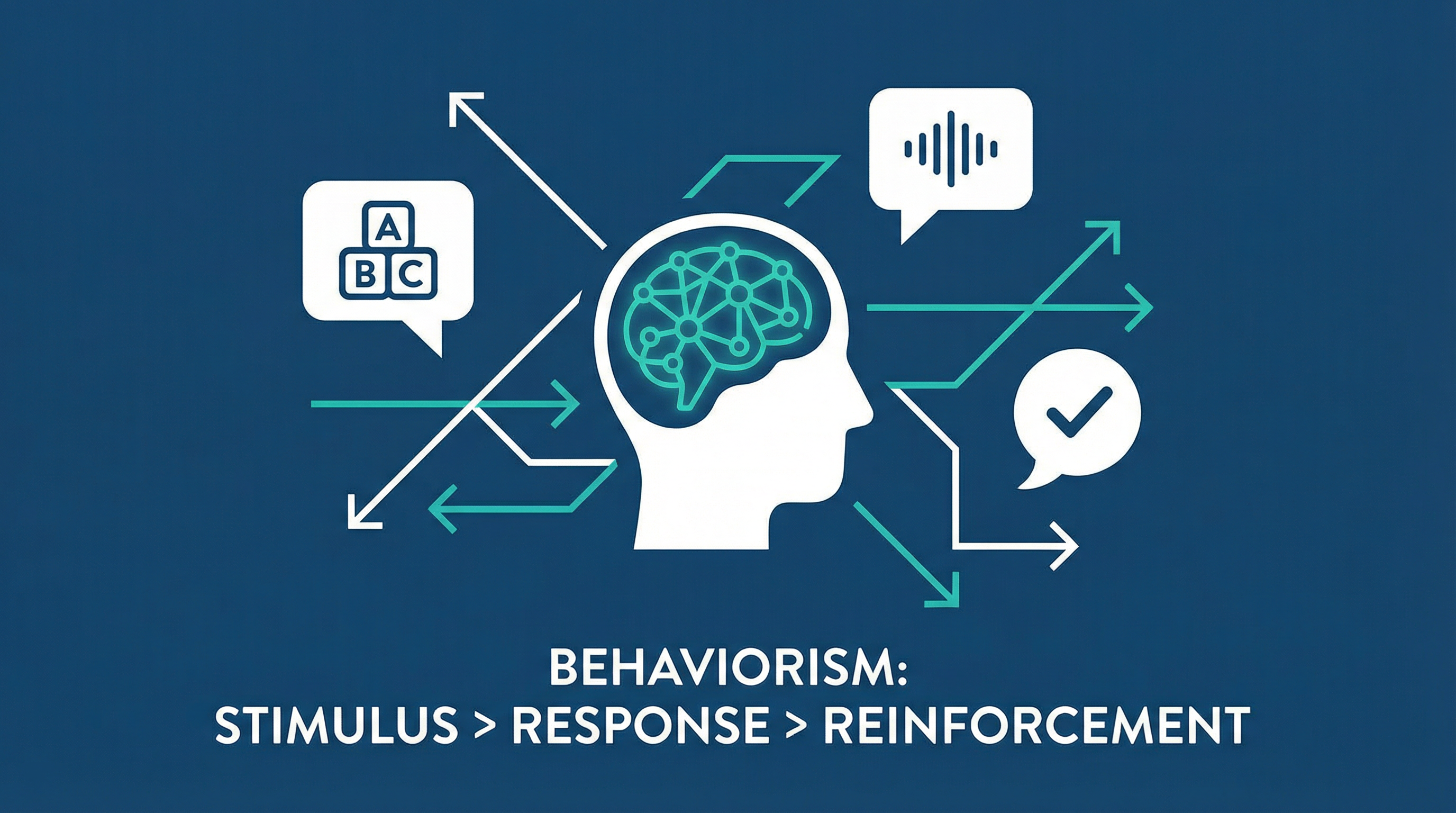
Behaviorism Concept Illustration

FIG 1.0: THE BEHAVIORIST MODEL

The Science of Habit Formation

Behaviorism views language learning not as a mental process, but as a mechanical one. It suggests that language is a behavior acquired through conditioning, just like any other skill. According to behaviorist theory, learners do not need to understand the underlying rules of grammar or the cognitive processes involved in language production. Instead, they develop automatic responses through repeated exposure to stimuli and consistent reinforcement of correct responses. This perspective dominated language teaching methodology from the 1940s through the 1960s, giving rise to influential approaches such as the Audio-Lingual Method, which emphasized pattern drills, mimicry, and memorization. The theory posits that errors are not a natural part of learning but rather bad habits that must be prevented or immediately corrected to avoid fossilization.

Stimulus & Response
Learning occurs when a specific stimulus triggers a specific response. In language teaching, this often takes the form of teacher prompts and student replies. The stimulus-response bond is the fundamental unit of learning in behaviorist theory. For example, when a teacher shows a picture of an apple (stimulus) and the student says "apple" (response), a connection is formed. Through repeated pairings, this association becomes automatic and habitual. This principle derives from classical conditioning experiments, where neutral stimuli become associated with meaningful responses through repeated exposure. In the language classroom, stimuli can include visual cues, audio prompts, written text, or teacher questions, all designed to elicit specific linguistic responses from learners.
Repetition & Drilling
"Practice makes perfect." Behaviorism emphasizes that language habits are formed through frequent, systematic repetition and mechanical drills. The theory holds that language structures must be practiced repeatedly until they become automatic, requiring no conscious thought. This is why behaviorist classrooms feature extensive drill work, including substitution drills, transformation drills, and repetition exercises. The underlying assumption is that language proficiency develops through the formation of strong neural pathways created by repetitive practice. Each repetition strengthens the stimulus-response bond, making the correct response more likely to occur automatically in future encounters. This approach mirrors how physical skills like typing or playing an instrument are developed through repeated practice until movements become fluid and unconscious.
Reinforcement
Positive reinforcement (praise, rewards) strengthens correct habits, while negative reinforcement or correction extinguishes incorrect ones. This principle, derived from operant conditioning theory developed by B.F. Skinner, suggests that behaviors followed by positive consequences are more likely to be repeated, while those followed by negative consequences are less likely to recur. In language classrooms, teachers use various forms of reinforcement: verbal praise ("Excellent!"), nonverbal approval (smiles, nods), tangible rewards (stickers, points), or simply the satisfaction of getting the answer correct. Immediate feedback is crucial—reinforcement must follow the response quickly to establish a strong connection. Conversely, errors should be corrected immediately to prevent the formation of bad habits. This creates a learning environment where correct language use is consistently rewarded and incorrect use is systematically discouraged.