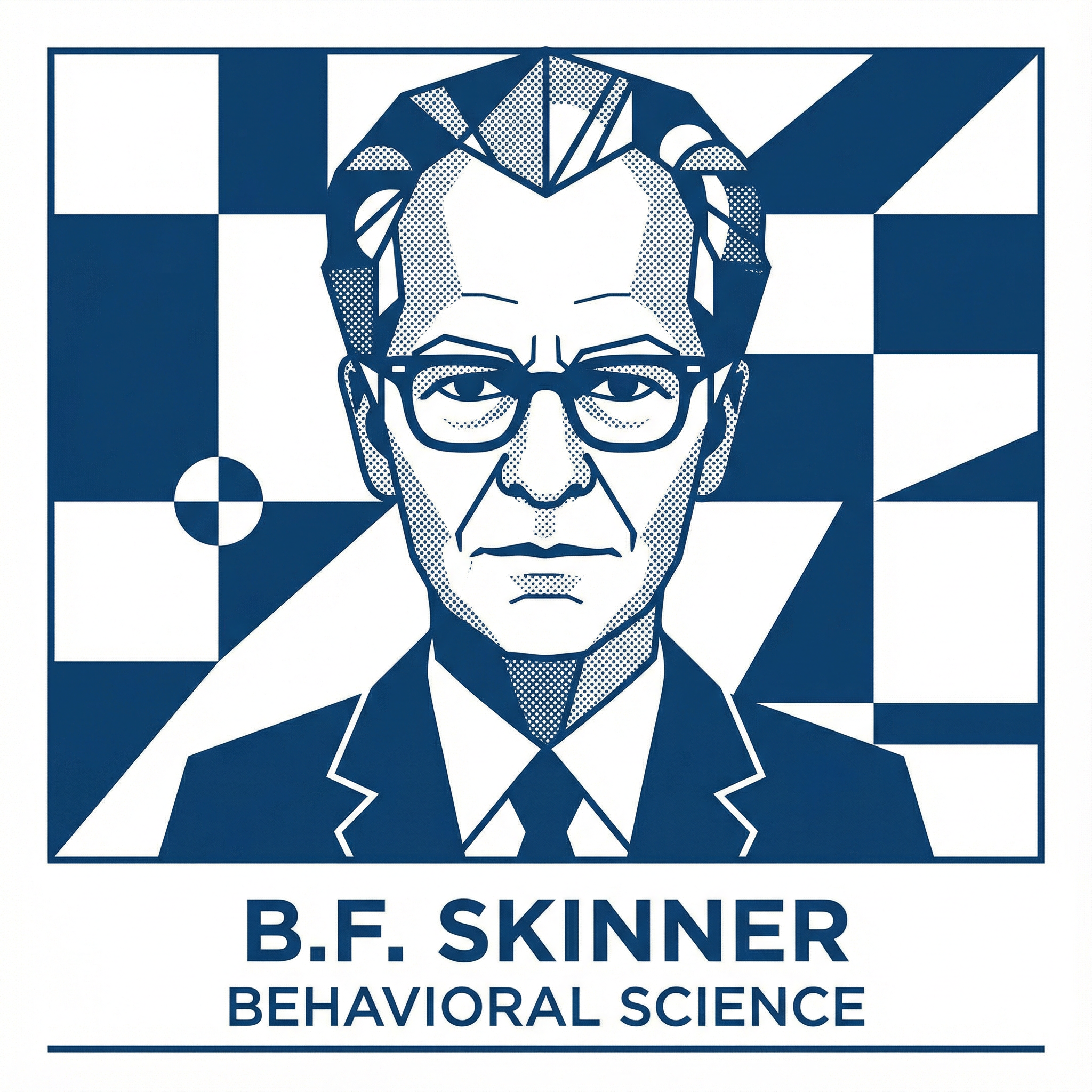
Burrhus Frederic Skinner
The Father of Operant Conditioning
B.F. Skinner is arguably the most influential behaviorist in the field of language learning. His 1957 book, Verbal Behavior, applied the principles of operant conditioning to language acquisition. Skinner's work represented the culmination of behaviorist thinking about language, attempting to provide a comprehensive account of how linguistic behavior is acquired, maintained, and modified through environmental contingencies. Unlike earlier behaviorists who focused primarily on simple reflexes and associations, Skinner developed a sophisticated framework for analyzing complex verbal behavior, including categories such as mands (requests), tacts (labels), echoics (imitations), and intraverbals (associations between verbal stimuli and verbal responses). His influence on language teaching was profound, providing the theoretical justification for the Audio-Lingual Method and other drill-based approaches that dominated mid-20th century language education.
Key Contributions
- Operant Conditioning: Proposed that learning is a function of change in overt behavior. Changes in behavior are the result of an individual's response to events (stimuli) that occur in the environment. Unlike Pavlov's classical conditioning, which dealt with involuntary reflexes, Skinner's operant conditioning focused on voluntary behaviors that are shaped by their consequences. He demonstrated through extensive laboratory research with rats and pigeons that complex behaviors could be built up through a process of successive approximation, where increasingly accurate responses are selectively reinforced. This principle was directly applied to language teaching, where teachers reinforce progressively more accurate approximations of target language forms.
- Verbal Behavior: Argued that language is a behavior like any other, acquired through reinforcement from the community (parents, teachers, peers). Skinner rejected the notion that language required special cognitive mechanisms or innate knowledge, instead proposing that all aspects of language use could be explained through the same principles of operant conditioning that governed other behaviors. He argued that children learn to speak because their verbal behaviors are reinforced by the responses they elicit from caregivers and others in their environment. This functional approach to language emphasized the communicative purposes of utterances rather than their formal grammatical properties, a perspective that influenced later communicative approaches to language teaching despite the general rejection of behaviorist theory.
- Reinforcement Schedules: Demonstrated how different patterns of reinforcement affect the speed and persistence of learning.
"The consequences of behavior determine the probability that the behavior will occur again."