Classroom Applications
Practical techniques and activities derived from behaviorist theory for the language classroom. Behaviorist principles have been translated into concrete teaching methodologies that dominated language education for decades and continue to influence contemporary practice. These applications demonstrate how theoretical concepts of stimulus-response conditioning, habit formation, and reinforcement can be operationalized in instructional settings.
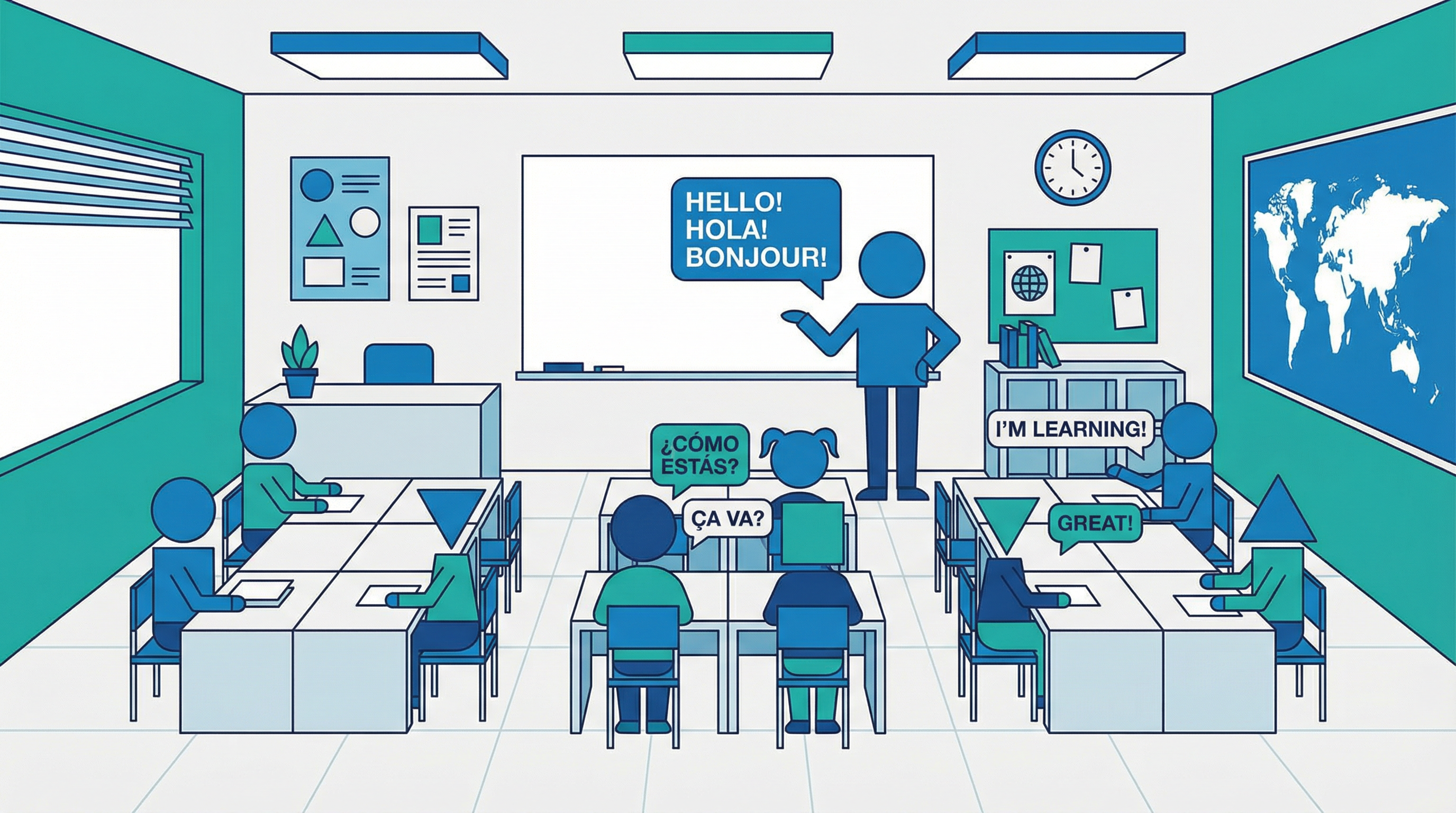
The Audio-Lingual Method (ALM)
The most prominent application of behaviorism in language teaching is the Audio-Lingual Method (also known as the Army Method). It emphasizes oral skills and aims to form habits through drilling. Developed during World War II to rapidly train military personnel in foreign languages, the ALM became the dominant approach to language teaching in the United States during the 1950s and 1960s. The method is grounded in the belief that language learning is fundamentally a mechanical process of habit formation achieved through repetitive practice. Lessons typically begin with dialogues that students memorize through mimicry and repetition, followed by pattern drills that isolate and practice specific grammatical structures. The teacher serves as a model of correct language use, and students are expected to imitate that model as accurately as possible. Grammar rules are not explicitly taught; instead, students are expected to internalize patterns through repeated exposure and practice. The goal is to develop automatic, unconscious control of language structures that can be deployed rapidly in real communication.
- New material is presented in dialogue form
- Dependence on mimicry, memorization of set phrases, and over-learning
- Structures are sequenced by means of contrastive analysis and taught one at a time
- Structural patterns are taught using repetitive drills
- There is little or no grammatical explanation
Drilling Techniques
Drills are the core technique of behaviorist teaching. They are designed to make language automatic. The underlying rationale is that language proficiency develops through the formation of strong stimulus-response bonds that enable learners to produce correct forms without conscious thought. Drills provide intensive, focused practice on specific linguistic patterns, allowing students to produce the same structure multiple times in rapid succession. This repetition is believed to strengthen the neural pathways associated with that pattern, making it increasingly automatic. Effective drills are carefully structured to isolate one linguistic feature at a time, preventing confusion and ensuring that students can focus their attention on forming the correct habit. The teacher's role is to provide clear models, maintain a brisk pace, and offer immediate correction of errors to prevent the formation of bad habits. While drills have been criticized for being mechanical and divorced from meaningful communication, proponents argue that they provide essential practice that frees up cognitive resources for more complex language tasks.
Modern Application
While pure behaviorism is rare today, these techniques are still valuable for specific pedagogical purposes. Contemporary language teaching has largely moved beyond the strict behaviorist approach, recognizing that language learning involves cognitive processes that cannot be reduced to habit formation. However, many teachers continue to use behaviorist techniques selectively, particularly in the following contexts:
- Pronunciation practice
- Memorizing vocabulary
- Internalizing complex grammar structures
- Building confidence in beginners